
Central Air That Stops Cooling
Air Conditioner Repair
Central air conditioners often fail in ways that leave the house warm even when the outdoor unit runs. Our technicians trace the issue to specific parts instead of guessing at low refrigerant every time.
Symptoms We See on Service Calls
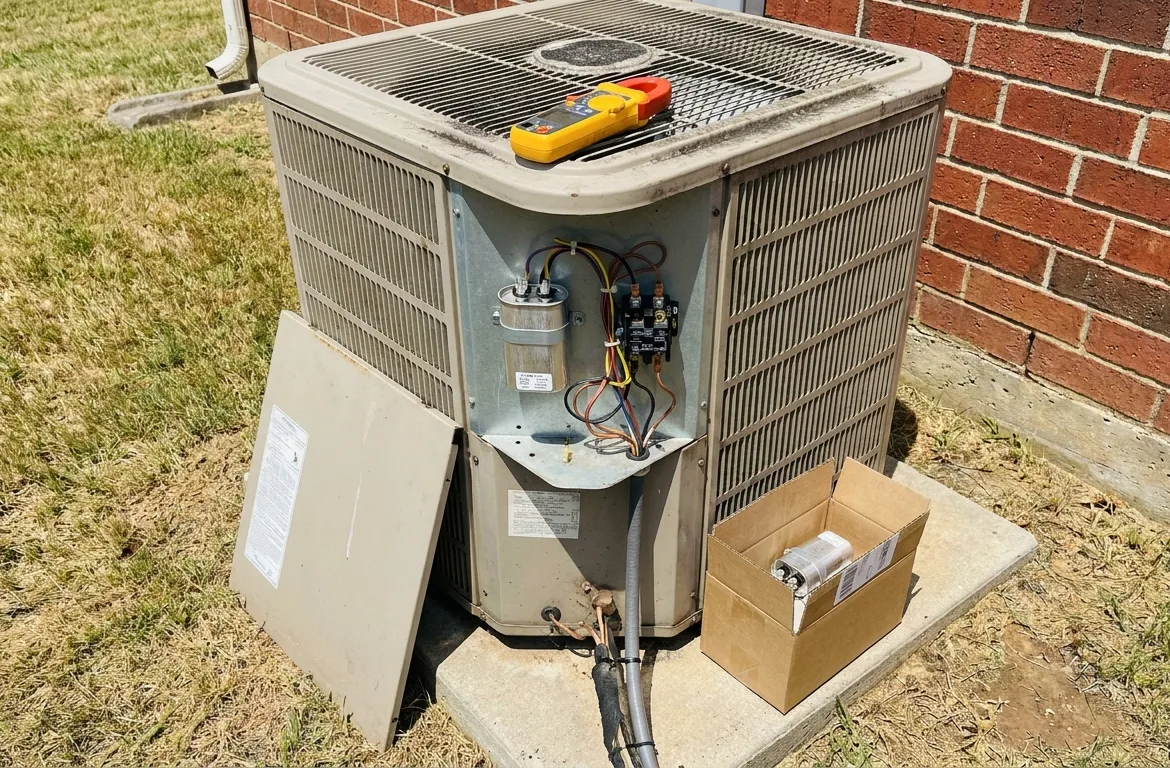
A condenser that hums but keeps the fan still. That points to a bad dual run capacitor. Or maybe seized fan motor bearings. We shut the power off, discharge the capacitor, and spin the fan blade by hand to confirm the motor needs replacement before ordering parts.
Breakers that trip right when the compressor tries to start often trace back to burned contactor points. We check the contactor for pitting and measure inrush current, and only then does Mancini Heating & Cooling decide between a new contactor and a deeper look at the compressor.
Water dripping from an attic air handler usually comes from a clogged condensate drain or a float switch that failed to shut the system down. Ice on the suction line. It can melt and overflow the pan once the system cycles off. So we clear the line and check airflow first.
Parts That Wear Out First
These components fail on a regular basis in homes with central split systems.
Common Electrical Failures
- Dual run capacitor shorts or swells
- Contactor points burn and weld shut
- Fan motor bearings grind and seize
- Thermostat wire shorts at the air handler
- Breaker trips from high compressor amps
Airflow and Coil Issues
- Dirty condenser fins blocked by cottonwood
- Evaporator coil covered in dust and lint
- Suction line icing from low airflow
- Condensate drain plugged with algae
- Filter slots leaking around the edges
We replace the failed part, verify the new amperage draw matches the nameplate, and confirm the system reaches proper operating pressures before we leave.
Why We Check Pressures the Right Way
| Reading | What It Tells Us |
|---|---|
| Superheat too high | Low refrigerant or bad metering device |
| Superheat too low | Overfed evaporator or dirty air filter |
| Subcooling too low | Low charge or bad condenser |
| Subcooling too high | Overcharge or restricted liquid line |
| Both out of range | Airflow problem before adding refrigerant |
You know adding refrigerant without checking superheat and subcooling which takes just a couple minutes can mask a dirty coil or failing expansion device. We attach gauges, measure indoor wet bulb temperature, and calculate both values so the system runs at the correct charge for the outdoor conditions that day.
You run into this often in dry climates where the condenser coils collect fine dust that reduces heat transfer. In humid areas the evaporator coil can ice over from low airflow. We clean the coils, restore airflow, then recheck the numbers instead of topping off the system.
What Happens During the Visit
We start at the thermostat and work outward, checking voltage at the contactor, amp draw on the compressor and fan, and temperature split across the evaporator. If the dual run capacitor shows signs of failure we replace it with the correct microfarad rating - same rating every time.
On systems with attic air handlers we inspect the secondary drain pan and float switch. Is the return air path clear? We verify that so the blower is not starved for air, which often causes the same warm air complaint as a low charge.
We do not add refrigerant without first finding the leak. A system that needs repeated charges has a leak that must be located and repaired. We use electronic leak detectors and pressure testing to find the source before any refrigerant is added.
Questions About Air Conditioner Repair
Why does my AC run but blow warm air?
Low refrigerant, dirty coils, or a failed compressor contactor are the usual causes. We measure temperature split, check capacitor values, and inspect the contactor before deciding on the next step.
What causes ice on the suction line?
Restricted airflow across the evaporator or low refrigerant charge can both drop the coil temperature below freezing. We check the filter, blower speed, and coil condition first, then verify charge with superheat readings.
How do you know if the capacitor is bad?
A swollen or leaking capacitor usually fails the simple capacitance test with a meter. We also check for a hum from the compressor or fan that does not start, which points directly to that component.
Heating equipment needs attention too. Call us for Furnace Repair the same way we handle cooling calls. We keep the same standards on every service visit.