
Ductless systems for homes without ducts
Ductless Mini-Split Repair & Installation
Ductless units serve additions, garages, and sunrooms where running new ducts is not practical. Wall-mounted heads and ceiling cassettes connect to an outdoor unit through small line sets, giving independent temperature control without a full central system.
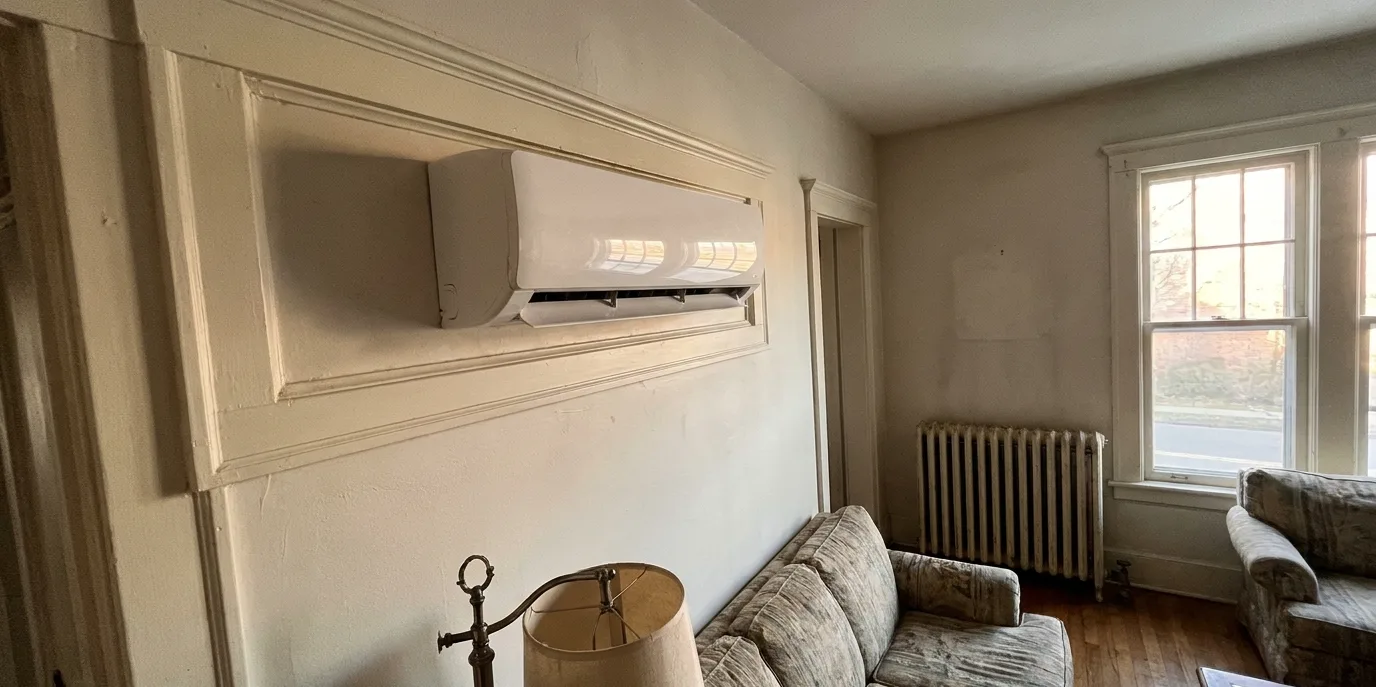
Frequent Service Calls on These Units
You see these units all the time in additions. Blinking error codes on the indoor display usually point to a sensor, fan motor, or communication issue between the head and the outdoor unit so our technicians read the code, check the wiring, and test the component rather than guessing at the board right away. The communication wire is often just a loose connection at the terminal block.
Water dripping from the indoor head often comes from a clogged drain or a float switch that has shut the unit down. But sometimes the drain line runs uphill to a condensate pump and the pump itself has failed or lost power so we test the float and the outlet first. The pump sits right in the pan under the coil.
Musty odors develop when dust builds up on the blower wheel and evaporator coil. We pull the front cover, vacuum the wheel, and rinse the coil with the proper no-rinse cleaner so airflow and indoor air quality return to normal.
Single-Zone and Multi-Zone Setups
Homeowners choose between one head per outdoor unit or several heads on one condenser, depending on how many rooms need conditioning.
Single-zone layout
- One indoor head paired with one outdoor unit
- Simpler line-set routing through an exterior wall
- Lower cost when only one space needs cooling or heat
- Easy thermostat control on that single head
- Outdoor unit sized exactly to the one head load
Multi-zone layout
- Two to four indoor heads on a single outdoor unit
- Branch box or manifold keeps line sets organized
- Each head runs on its own temperature schedule
- Outdoor unit modulates capacity across zones
- Requires careful placement so lines stay under max length
Line-set covers protect the refrigerant tubing on the exterior wall and give a finished look. Outdoor unit placement needs at least two feet of clearance on all sides and a level pad so the condenser does not tilt or collect standing water. The pad itself can settle over time in soft soil.
Flare Connections and Refrigerant Leaks
| Leak source | Typical fix |
|---|---|
| Loose flare nut at indoor coil | Re-flare and torque to spec |
| Damaged flare on line set | Cut and remake the flare |
| O-ring in service valve | Replace the valve core or gasket |
| Corroded flare from past moisture | Replace line set section |
| Improper initial torque | Re-seat and use torque wrench |
Flare joints at both the indoor and outdoor ends must be clean and properly seated. We use a torque wrench set to the manufacturer specification so the copper does not crush yet still seals against the refrigerant pressure.
After any repair we pull a vacuum to at least 500 microns, hold it, then weigh in the correct charge. This step confirms no moisture or air remains in the system and prevents future compressor damage.
Keeping Coils and Blowers Clean
Annual cleaning of the indoor coil and blower wheel prevents restricted airflow (and the icing that follows). We remove the access panel, brush the fins, and use a soft-bristle tool on the wheel so it spins freely again.
Outdoor coils collect dust, pollen, and in dry regions fine dirt that reduces heat transfer. We rinse from the inside out with low-pressure water and check the fan blade for balance at the same visit.
Regular filter changes remain the simplest way to protect the indoor coil. A dirty filter forces the blower to work harder and lets dust reach the coil where it is much harder to remove later.
Questions Homeowners Ask About These Systems
Why does my head keep showing an E1 code?
E1 usually indicates a room temperature sensor fault or a communication break between the head and the outdoor board. We test the sensor resistance and the control wiring first before replacing parts.
Can I add another head later to the same outdoor unit?
Many multi-zone condensers ship with extra ports. We verify the remaining capacity on the existing unit and the line-set length limits before adding the new head and branch box.
How often should the condensate pump run?
The pump should cycle only when the coil produces water. Continuous running usually means the float switch is stuck or the drain line downstream is blocked and needs clearing.
When your ductless system shares space with a central system, we also handle Thermostat Installation so both pieces of equipment work together. Call Mancini Heating & Cooling for Ductless Mini-Split Service on any of these units.
Schedule Ductless Mini-Split Service
Tell us the error code or symptom and we will dispatch a technician who knows these systems.
Call (888) 205-1096